))
DCAA INSIGHTS · RESEARCH & ANALYSIS
Research & Analysis ·
A-FLOW’s ML1 Data Center in Laguna has achieved LEED Gold certification under a rating system specifically designed for data-centre buildings. It is a significant sustainability milestone — but it also provides a useful opportunity to ask a broader question: when a data centre says it is “certified”, what does that certification actually tell us?
At a glance
On 26 October 2026, A-FLOW announced that its ML1 Data Center in Laguna had achieved LEED Gold certification under LEED v4 Building Design and Construction (BD+C): Data Centers.
ML1 is A-FLOW's first operational data centre in the Philippines.
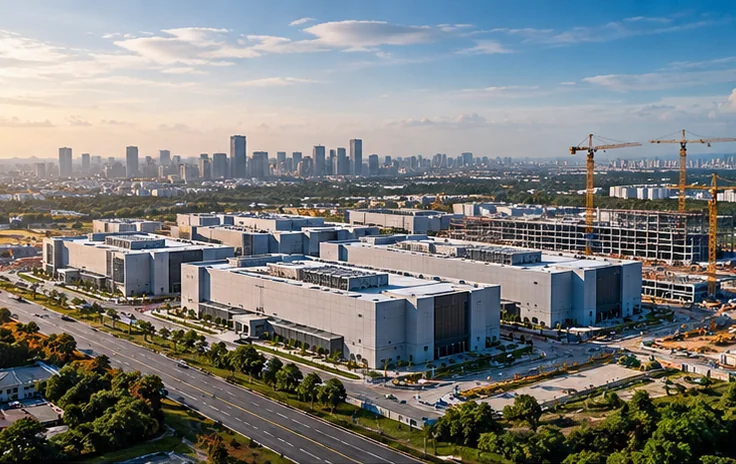
The first building provides 6 MW of live IT capacity and forms part of a planned three-building campus capable of supporting up to 36 MW of IT load.
The certification is important.
LEED — Leadership in Energy and Environmental Design — is an internationally recognised green-building framework developed by the U.S. Green Building Council.
For ML1, achieving Gold under the BD+C: Data Centers rating system provides evidence that the building has been assessed against defined environmental and sustainability criteria covering areas including:
- energy performance;
- water efficiency;
- materials and resources;
- indoor environmental quality; and
- innovation.
But it is equally important to understand what the certification does not automatically tell us.
LEED Gold is not, by itself, a statement that a data centre has achieved a particular level of electrical or cooling redundancy, operational maturity, information-security management or business-continuity capability.
Those areas may be addressed through other standards, certifications and operating practices.
That distinction is useful well beyond ML1.
As more Philippine data centres announce certifications, customers and industry professionals increasingly need to ask:
Certified to what — and what exactly was assessed?
What has A-FLOW achieved?
A-FLOW is a joint venture between FLOW Digital Infrastructure and AyalaLand Logistics Holdings Corp.
The companies began developing the Laguna campus in 2022, and ML1 was formally launched in November 2025 as A-FLOW's first operational Philippine data centre.
The facility sits approximately 35 kilometres south of Metro Manila and forms the first building of a planned three-building greenfield campus.
A-FLOW says ML1 currently provides 6 MW of live IT capacity, while the wider campus is designed to accommodate up to 36 MW of IT load.
In January 2026, A-FLOW also announced the addition of Globe Telecom, Radius Telecoms and Source Telecoms as connectivity providers at ML1, supporting its carrier-neutral positioning.
The October LEED Gold announcement adds another dimension to that development story:
sustainability performance at the building-design and construction level.
What is LEED BD+C: Data Centers?
LEED is not one single certification applied identically to every type of building.
Different LEED rating systems address different stages and types of development.
BD+C — Building Design and Construction focuses on the design and construction of new buildings and major renovations.
Within LEED v4, there is a specific BD+C pathway for Data Centers.
That matters because data centres are unusual buildings.
They contain highly concentrated electrical loads.
They can require significant cooling.
They operate continuously.
And a large proportion of their environmental impact can come from the infrastructure required to support IT equipment rather than from traditional office occupancy.
LEED therefore provides a structured way to assess sustainability characteristics across several aspects of the building.
Energy matters — but it is not the only measure
Energy performance is an obvious focus for data centres.
Servers consume electricity directly, while cooling systems, pumps, fans, power-conversion equipment and supporting infrastructure add additional demand.
LEED v4's Energy and Atmosphere framework considers energy efficiency, building-energy performance, metering and the use of renewable-energy strategies.
For data centres, that is highly relevant.
But LEED looks beyond electricity consumption alone.
Its wider framework also considers areas such as:
Water Efficiency — including water use, process water and metering.
Materials and Resources — including lifecycle impacts, material selection and construction waste.
Sustainable Sites — how site development affects the surrounding environment.
Indoor Environmental Quality — relating primarily to occupied areas of a building.
Innovation — recognising measures that go beyond standard requirements.
The important point is that LEED Gold represents performance across a defined sustainability framework, rather than a simple claim that a building is “green”.
Why water deserves particular attention
Water is becoming an increasingly important part of the data-centre sustainability conversation.
Depending on the cooling architecture used, data centres can consume water directly or indirectly as part of heat-rejection systems.
LEED's Water Efficiency framework considers indoor water, outdoor water, process uses such as cooling, and metering.
The system follows what USGBC describes as an “efficiency first” approach — reducing demand before considering alternative or non-potable sources.
That is particularly relevant in tropical markets such as the Philippines.
Cooling systems must operate in warm and humid conditions for much of the year.
As data-centre capacity expands, conversations around sustainability will increasingly need to consider both:
energy efficiency
and
water efficiency.
LEED provides one framework through which those questions can be assessed.
What LEED Gold does not automatically prove
This is where certification terminology can become confusing.
Seeing LEED Gold beside the name of a data centre may understandably create an impression of broad technical quality.
But certification frameworks have defined boundaries.
LEED principally evaluates green-building and sustainability performance.
It should not automatically be interpreted as evidence of every other characteristic a customer may care about.
For example, LEED Gold does not by itself establish:
- a particular level of electrical redundancy;
- a specific cooling-system redundancy architecture;
- concurrent maintainability;
- telecommunications-path diversity;
- a particular data-centre availability classification;
- information-security management maturity;
- business-continuity management maturity; or
- operational-process maturity.
Those areas are addressed through different standards, management systems, technical assessments and operating practices.
This does not reduce the value of LEED.
It simply means the certification needs to be understood according to its actual scope.
Different standards answer different questions
This is one reason data centres may reference several different standards or certifications.
For example:
LEED asks questions primarily about environmental design, construction and sustainability performance.
ANSI/TIA-942 addresses data-centre physical infrastructure, including telecommunications, electrical, mechanical, architectural, fire-protection, physical-security and monitoring requirements.
ISO/IEC 27001 addresses information-security management.
ISO 22301 addresses business-continuity management.
ISO 50001 addresses energy-management systems.
These frameworks may complement one another.
But they are not interchangeable.
A facility can perform strongly against one framework while another framework is assessing an entirely different area.
That is why the useful question is not simply:
“How many certifications does this data centre have?”
A better question is:
“What risk or performance area does each certification address?”
Sustainability certification and operational performance
There is another important distinction.
ML1's certification was awarded under LEED v4 BD+C, which focuses on building design and construction.
USGBC also maintains separate LEED pathways for the operation and maintenance of existing buildings.
This illustrates a broader principle.
How a facility is designed and constructed matters.
But how it is operated over the following ten or twenty years matters as well.
A building may begin with efficient equipment and strong environmental design.
Over time, however:
- operating conditions change;
- IT loads increase;
- cooling configurations evolve;
- equipment ages;
- maintenance practices affect efficiency;
- operating teams change;
- and new technologies are introduced.
Long-term sustainability therefore requires more than an initial design objective.
It requires continued measurement, maintenance and operational discipline.
Why ML1 matters to the Philippine market
A-FLOW's certification is significant partly because of where ML1 sits in the development of the Philippine data-centre market.
The country is seeking to attract more cloud, hyperscale and AI-related infrastructure.
That growth brings an unavoidable increase in demand for:
power
cooling
water
land
connectivity
and technical capability.
The sustainability performance of new facilities therefore matters not only to operators.
It matters to utilities, customers, investors, policymakers and the communities in which these facilities are developed.
The question is increasingly not simply:
Can the Philippines build more data centres?
It is also:
How efficiently and sustainably can those facilities be built and operated?
ML1's LEED Gold milestone provides one practical Philippine example of that transition.
What customers should ask when they see “certified”
As certification becomes more visible in the Philippine data-centre market, customers do not necessarily need to become standards specialists.
But they should understand the basics.
When an operator describes a facility as certified, useful questions include:
What standard or rating system applies?
What exactly was assessed?
Was the design assessed, the completed facility, the management system or ongoing operations?
Who performed the assessment?
Does the certification have an expiry or reassessment requirement?
What important areas fall outside its scope?
The answers provide more meaningful information than the word certified by itself.
DCAA perspective
A-FLOW ML1's LEED Gold certification is a positive milestone for Philippine digital infrastructure.
It demonstrates that sustainability considerations are becoming part of how new data-centre developments in the country are being designed and delivered.
But its wider value is also educational.
Certification works best when its meaning is understood.
LEED Gold tells us something meaningful about ML1's performance against a recognised green-building framework.
It should be recognised for what it demonstrates.
It should not be stretched into claims about areas the certification was never designed to assess.
The same principle applies across the data-centre industry.
A resilience certification should be understood within its infrastructure scope.
An information-security certification should be understood within its management-system scope.
A sustainability certification should be understood within its environmental scope.
And operational performance ultimately depends on how infrastructure, processes and people continue working together after the certificates have been awarded.
For customers, developers and operators, the objective should therefore not simply be to accumulate badges.
It should be to understand which risks are being assessed, which requirements are being demonstrated and where additional assurance may still be required.
As the Philippine data-centre market grows, that distinction will become increasingly important.
BUILD THE INFRASTRUCTURE. BUILD THE WORKFORCE.
Sources & Further Reading
- A-FLOW / FLOW — ML1 LEED Gold announcement →
- FLOW — ML1 facility page →
- FLOW — A-FLOW ML1 launch →
- FLOW — ML1 telecommunications partners →
- U.S. Green Building Council — LEED v4 →
- U.S. Green Building Council — LEED BD+C Guide →
- U.S. Green Building Council — LEED for new buildings →
- U.S. Green Building Council — LEED certification timelines / rating systems →
Editorial Notice
DCAA Insights is provided for general industry information and professional education. Sourced information and third-party statements are attributed to their original publishers. DCAA commentary and analysis are identified as such. References to companies, projects or external resources do not constitute endorsement. External publications remain the intellectual property of their respective owners. Readers should refer to the original sources for the latest information.