))

DCAA INSIGHTS · RESEARCH & ANALYSIS
Research & Analysis ·
A data centre can have enormous network capacity and still be vulnerable. True connectivity resilience depends on where cables land, how routes are diversified, whether infrastructure shares common failure points, and how effectively operators respond when something goes wrong.
At a glance
A submarine connectivity disruption on 2 October 2026 affected international internet traffic between the Philippines and Singapore, with users across several Philippine networks reporting slower or intermittent access to overseas services. Major operators rerouted traffic through alternative international links, and services subsequently normalised.
GMA News — Philippine international connectivity disruption
Converge said most of its rerouted traffic moved through its newer Bifrost cable capacity. Globe separately reported that cable and equipment theft had caused 1,245 pilferage incidents as of September 2026, resulting in site outages.
Converge ICT Solutions — International cable investments and Philippines–Singapore disruption
These two events were very different.
But together they demonstrate an important principle:
Connectivity resilience is not simply about bandwidth.
It depends on international route diversity, domestic path diversity, physical security, redundancy, monitoring and the ability to recover when infrastructure fails.
What is a submarine cable?
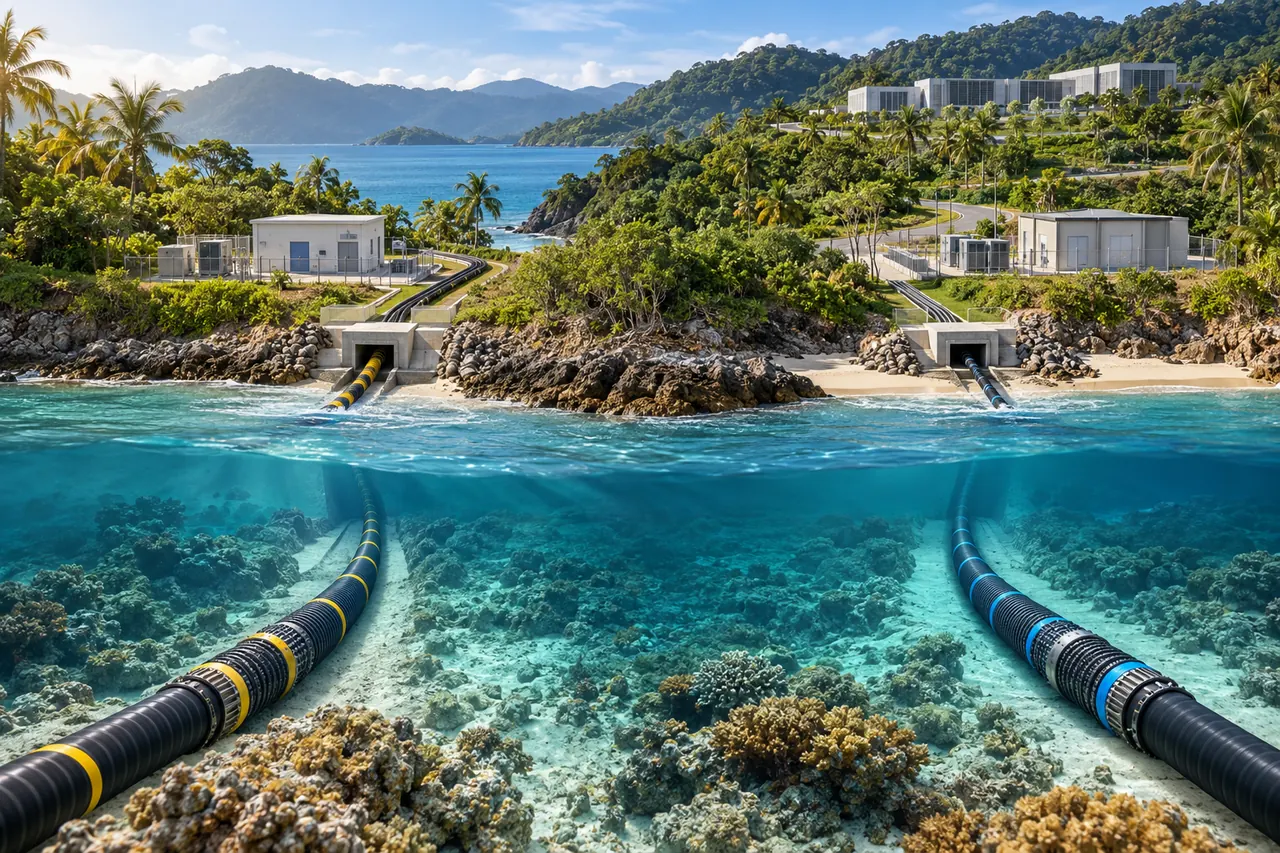
In simple terms, submarine cables are fibre-optic cables laid across the ocean floor. They carry most international internet traffic between countries. When one route fails, networks need alternative routes to keep data moving.
A Philippine connectivity disruption: what October demonstrated
On the evening of 2 October, a submarine cable segment between the Philippines and Singapore went offline, alongside reports of an affected Philippines–Hong Kong segment. Users of several networks reported slower or intermittent international connectivity. DICT began investigating the disruption.
DZRH — Undersea cable segments reported offline
PLDT, Globe and Converge rerouted affected traffic through alternative international links.
Converge later said it had stabilised services with none to minimal disruption for its residential and enterprise customers after shifting traffic primarily through Bifrost. Some customers had difficulty accessing applications and websites hosted in Singapore.
Converge ICT Solutions — International cable investments and Philippines–Singapore disruption
Importantly, this does not establish that Philippine data centres themselves suffered outages.
A telecommunications disruption can degrade access to services without taking down the facility hosting those services. A data centre may remain fully operational while customers encounter higher latency or reduced international capacity outside the facility.
That distinction matters when discussing resilience.
Subsequent reporting identified the restored Philippines–Singapore segment as part of the C2C system, although major operator advisories generally referred only to a Philippines–Singapore cable disruption. InfiniVAN reported the segment restored and under monitoring on 3 October, while PLDT and Globe said services had fully normalised by 4 October.
PhilSTAR Tech — Philippines–Singapore cable restoration
The exact physical cause and location of the fault were not consistently established in the operator material reviewed.
But the event still provided a useful real-world test:
Could traffic find another path when a major international route became unavailable?
In several cases, the answer was yes.
Why submarine cable diversity matters
Submarine telecommunications cables carry the overwhelming majority of international data exchange. The International Telecommunication Union says they handle more than 99% of international data traffic and warns that resilience depends partly on geographic diversity, infrastructure redundancy and preparedness for disruption.
International Telecommunication Union — Submarine cable resilience
For the Philippines, an archipelagic economy connected internationally by subsea infrastructure, that makes cable diversity strategically important.
The point is not that more cables automatically eliminate risk.
Two cables can still share the same landing area, terrestrial route, duct, power dependency or upstream facility.
Diversity must be physical, not merely numerical.
Mapping the Philippines' international connectivity
Converge's Bifrost system connects the Philippines through Davao to Singapore, Indonesia, Guam and the United States. Its SEA-H2X system lands in La Union and provides another route linking the Philippines with locations including Singapore, Thailand, Hong Kong and Hainan. During the October incident, Converge said these newer systems provided the redundancy needed to shift affected traffic.
Converge ICT Solutions — International cable investments and Philippines–Singapore disruption
Other Philippine operators are also expanding route diversity.
PLDT's international network includes systems connecting the Philippines to Japan, Singapore, Hong Kong and the United States, including Jupiter, Asia Direct Cable and Apricot. Apricot uses Philippine landing points in Baler and Davao and follows a route intended to provide additional geographic diversity.
PLDT Enterprise — Apricot submarine cable system
Globe announced in April 2026 that it had joined the CANDLE consortium, which is developing a system linking Japan, Taiwan, the Philippines, Indonesia, Malaysia and Singapore, with operations expected in 2028. Globe specifically pointed to west- and east-coast Philippine landing arrangements as a resilience measure against natural hazards and common points of failure.
Globe Telecom — CANDLE submarine cable consortium
For a broader global view of submarine cable systems and landing points, use the external TeleGeography reference:
TeleGeography — Global Submarine Cable Map
TeleGeography — 2026 Submarine Cable Map
Cable landing stations are only one part of the chain
A submarine cable does not connect directly to a server.
It comes ashore through a cable landing station, then connects to terrestrial fibre and onward network infrastructure before reaching data centres, internet exchanges, cloud platforms and users.
That means resilience must be assessed end-to-end.
A country may have multiple international cable systems, but if too many routes converge through the same landing area or terrestrial corridor, a single physical incident can still affect several services.
The ITU's 2026 submarine-cable resilience work specifically highlights the risks created by geographic concentration and dependence on a limited number of routes. Its recommendations include improved risk identification, geographic diversity, infrastructure redundancy and stronger preparedness and response.
International Telecommunication Union — Submarine cable resilience
For data-centre customers, this raises practical questions:
Does the facility connect to more than one carrier?
Do those carriers actually use different physical paths?
Do international routes leave the country through different landing points?
Do redundant fibre links enter the data centre from genuinely separated directions?
And are hidden dependencies — shared ducts, poles, exchanges, power supplies or access roads — understood?
A diagram may show two network connections.
Operational resilience depends on whether they can genuinely fail independently.
Domestic networks have physical vulnerabilities too
International submarine cables are only one part of the problem.
On 5 October, Globe reported 1,245 cases of telecommunications-equipment pilferage as of September 2026, involving Globe and its tower-company partners. The operator said the incidents had resulted in service outages and disruption to mobile and data connectivity.
Globe Telecom — Telecommunications cable and equipment pilferage incidents
This is a very different risk from a subsea cable fault.
But the operational lesson is similar.
Digital services ultimately depend on physical infrastructure.
Fibre can be cut. Equipment can be stolen. Power can fail. Construction work can damage ducts. Flooding and typhoons can affect access. A redundant route can become ineffective if both paths share the same vulnerable physical corridor.
Globe has separately backed a more coordinated approach to underground conduit infrastructure, arguing that fragmented implementation contributes to fibre cuts and infrastructure vulnerability.
Globe Telecom — Unified underground infrastructure and fibre resilience
For data-centre resilience, this means that external telecommunications routes should be treated in much the same way as other critical utilities:
their physical dependencies matter.
From redundancy to recovery
Resilience is often confused with redundancy.
They are related, but they are not the same.
Redundancy provides alternative equipment or paths.
Resilience is the ability of the overall system to continue operating, adapt when something fails, and recover effectively.
A data centre could have two telecoms providers and still be vulnerable if both use the same external route.
It could have diverse paths but ineffective failover configuration.
It could successfully fail over but lack enough alternative capacity to handle normal traffic.
Or technical redundancy could work perfectly while operational teams take too long to diagnose the incident.
That is why connectivity resilience also depends on:
- carrier diversity;
- physically diverse routing;
- sufficient backup capacity;
- failover configuration;
- monitoring and alerting;
- tested incident procedures;
- escalation paths;
- restoration arrangements;
- business continuity planning; and
- regular validation that redundancy still works as designed.
Recognised data-centre standards reflect this wider emphasis on availability and infrastructure resilience. ISO/IEC 22237 addresses telecommunications cabling infrastructure in the context of data-centre availability, while the 2026 edition of ISO/IEC TS 22237-31 defines resilience-related measures including dependability, fault tolerance, maintainability and recoverability.
ISO — ISO/IEC TS 22237-5 telecommunications cabling infrastructure
IEC — ISO/IEC TS 22237-31:2026 resilience KPIs
The technology is only part of the solution.
The rest is operational discipline.
Why this matters for Philippine data-centre competitiveness
For enterprises, cloud platforms and AI workloads, poor international connectivity can mean higher latency, reduced service availability and weaker access to customers and other computing regions.
For prospective data-centre investors, the issue is larger.
A site may have enough electricity and enough land, but if it cannot obtain robust domestic and international network diversity, its commercial attractiveness is weakened.
This is why headline bandwidth numbers should be interpreted carefully.
A cable system capable of hundreds of terabits per second may add tremendous capacity.
But capacity answers “how much?”
Resilience asks:
How many independent ways can the data get there — and what happens when one of them fails?
The Philippines is benefiting from significant investment in new international systems and landing infrastructure.
That is positive.
But resilience will ultimately be demonstrated during disruption rather than in capacity announcements.
DCAA perspective
The October cable disruption offered a practical reminder that infrastructure resilience is tested when systems stop behaving normally.
Alternative international routes allowed operators to redirect traffic.
But reliable data-centre operations require this thinking across the entire infrastructure environment.
Power, cooling, connectivity and physical security all depend on redundancy that is properly designed, maintained and tested — and on people capable of responding effectively when an incident occurs.
As Philippine data centres become larger and increasingly support cloud and AI workloads, operational maturity becomes as important as installed infrastructure.
Building more bandwidth strengthens capacity.
Designing diverse routes strengthens redundancy.
Testing systems, understanding dependencies and recovering effectively build resilience.
BUILD THE INFRASTRUCTURE. BUILD THE WORKFORCE.
Selected sources
- Converge ICT Solutions — International cable investments and PH–Singapore disruption (October 2026).
- GMA News — Philippine international connectivity disruption (October 2026).
- DZRH — Undersea cable segments reported offline (October 2026).
- PhilSTAR Tech — Philippines–Singapore cable restoration (October 2026).
- Globe Telecom — Telecommunications cable and equipment pilferage incidents (October 2026).
- Globe Telecom — Unified underground infrastructure / fibre resilience (October 2026).
- Globe Telecom — CANDLE submarine cable consortium (October 2026).
- PLDT Enterprise — Apricot submarine cable system (October 2026).
- TeleGeography — Global Submarine Cable Map (October 2026).
- TeleGeography — 2026 Submarine Cable Map (October 2026).
- International Telecommunication Union — Submarine cable resilience (October 2026).
- ISO — ISO/IEC TS 22237-5 telecommunications cabling infrastructure (October 2026).
- IEC — ISO/IEC TS 22237-31:2026 resilience KPIs (October 2026).
Editorial Notice
DCAA Insights is provided for general industry information and professional education. Sourced information and third-party statements are attributed to their original publishers. DCAA commentary and analysis are identified as such. References to companies, projects or external resources do not constitute endorsement. External publications remain the intellectual property of their respective owners. Readers should refer to the original sources for the latest information.