))

DCAA INSIGHTS · RESEARCH & ANALYSIS
Research & Analysis ·
As the Philippines plans new data-centre and AI infrastructure, water is emerging alongside power, land and connectivity as an important site consideration. With government and developers already discussing desalination in coastal locations, could seawater eventually play a wider role in how Philippine data centres manage heat?
Data centres generate heat continuously. As computing densities increase—particularly with artificial intelligence and other high-performance workloads—the infrastructure required to remove that heat is becoming an increasingly important part of data-centre design.
In the Philippines, much of the discussion around future data-centre development has understandably focused on electricity, connectivity, land and investment. But water and cooling are increasingly entering the conversation as well.
That raises an interesting question for an archipelagic country surrounded by the sea:
Could seawater become part of the Philippines’ future data-centre cooling strategy?
The answer is more complicated than simply having access to a coastline.
A question already being asked elsewhere
In a recent Tech Stories article, technology and data-centre writer Paul Mah examined whether seawater could be used to cool data centres following a panel discussion organised by Grundfos.
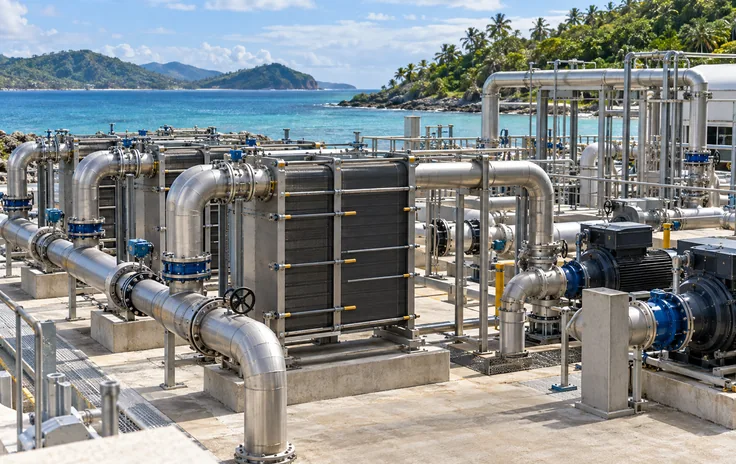
The concept itself is not new. Mah points to established applications of seawater cooling and describes what is generally an indirect system: seawater is drawn into a heat exchanger, where it cools a separate sealed water circuit serving the data centre. The seawater does not need to circulate through the facility's internal cooling infrastructure.
But seawater brings its own engineering challenges. It is highly corrosive, while marine organisms can cause biofouling in pipes, intakes and heat-exchange surfaces. Material selection, system design, inspection and maintenance therefore become critical. Tech Stories
Mah's conclusion is deliberately cautious: seawater cooling is proven technology, but it is not a universal solution. Whether it makes sense depends heavily on the site, workload, system design and economics. Tech Stories
That makes the question particularly interesting in a Philippine context.
The Philippines is already looking towards seawater
The connection between seawater and Philippine data centres is no longer entirely hypothetical.
In July 2026, Department of Information and Communications Technology Secretary Henry Aguda discussed water use in modern data centres and pointed to technologies including water recycling and desalination. He cited coastal locations including Batangas, Bataan and Cagayan, where access to saltwater could potentially support desalination rather than placing additional demand on conventional freshwater sources. GMA Network
The issue has also emerged in Aurora.
The Aurora Pacific Economic Zone and Freeport Authority has been promoting Casiguran as a potential location for future data-centre development. In September, APECO President and CEO Gil Taway IV said discussions around prospective data centres had included the establishment of a desalination facility because of the amount of water such developments could require.
Taway said APECO's intention would be to use seawater through desalination rather than relying on freshwater or groundwater. The proposed development remains at the planning and investment-discussion stage; it should not be interpreted as an operating data-centre or desalination project. Daily Tribune
APECO had already highlighted Casiguran's coastal position when discussing its potential as a future digital-infrastructure location. Philippine Information Agency
This creates an important distinction.
Desalination and seawater cooling are not the same thing
Using seawater to produce freshwater for cooling is technically different from using the sea itself as the cooling resource.
With desalination, seawater is treated to remove salt and other constituents. The resulting freshwater can then become part of a data centre's cooling or water-management system.
With indirect seawater cooling, the seawater itself absorbs heat through a heat exchanger before being returned to the marine environment. A physically separate freshwater circuit remains inside the data-centre cooling system.
A third possibility is deep seawater cooling, where colder water is drawn from greater ocean depths and used as the low-temperature heat sink.
These differences matter because each approach has a different energy, engineering, environmental and economic profile.
At present, DCAA has not identified verified evidence of an operating Philippine data centre using seawater directly as its primary external cooling heat sink.
What we do have is evidence that water availability, desalination and coastal siting are already becoming part of the Philippine data-centre infrastructure conversation.
Water and heat management are becoming site-selection issues
The Board of Investments has already identified water and heat management as factors that can influence both data-centre location and operating costs.
BOI notes that data-centre requirements extend beyond electricity: managing the water and heat associated with cooling can materially affect where facilities are built and how they operate. Board of Investments
This is particularly relevant as higher-density computing changes thermal requirements.
The question is therefore not simply whether enough electricity is available to operate a data centre.
It increasingly becomes:
Can the location support the complete infrastructure required to operate the facility reliably—including its cooling requirements?
For some coastal sites, seawater may become one part of that calculation.
What operating data centres overseas can tell us
There are established international examples demonstrating that seawater can form part of large-scale data-centre cooling.
Google's data centre in Hamina, Finland uses seawater from the Gulf of Finland as part of its cooling system. Google describes the seawater cooling arrangement as a central component of the site's energy-efficiency strategy. Google Data Centers
Norway's Lefdal Mine Data Centers offers an even clearer example of indirect seawater cooling.
The facility draws seawater at approximately 8°C from around 100 metres depth in the adjacent Nordfjord. The seawater passes through heat exchangers, cooling a separate pressurised freshwater circuit supplying the data centre. Lefdal says this system can support conventional air cooling as well as direct liquid and immersion cooling technologies. Lefdal Mine
The example is useful because it illustrates an important principle: using seawater does not mean pumping saltwater through servers or data halls.
Instead, the sea becomes the external heat sink.
But it also illustrates why geography matters.
Norway has access to naturally cold seawater. Philippine surface waters are considerably warmer, meaning a similar design could not simply be copied and transplanted to a tropical coastline.
Tropical seawater changes the equation
For tropical countries, potentially useful temperatures may require access to much deeper water.
A 2025 peer-reviewed study published in Renewable Energy examined a deep seawater cooling methodology for a hypothetical large data-centre cooling load in India's Andaman and Nicobar Islands—a tropical island environment with some geographical characteristics more relevant to the Philippines than northern-European case studies.
The research concluded that feasibility depends heavily on factors including seabed profile, pipeline design, water depth, capital investment and operating costs. ScienceDirect
That is an important lesson for the Philippines.
A data centre being located near the sea does not automatically make seawater cooling practical.
Engineers would need to know how rapidly the seabed descends, how far offshore sufficiently cold water exists, how long the intake pipeline would need to be, how much energy would be required to move the water and whether the resulting system could be maintained reliably throughout the life of the facility.
Those questions would need to be answered site by site.
Seawater is technically demanding
Temperature is only one consideration.
Seawater is corrosive. Pipework, pumps, heat exchangers and other components exposed to it need appropriate materials and protection.
Marine life presents another challenge. Barnacles, mussels, microorganisms and other organisms can accumulate on intake and heat-transfer surfaces, restricting flow and reducing thermal performance.
These are among the practical issues highlighted in Mah's discussion of seawater cooling. Tech Stories
For a data centre, the consequences of poor cooling-system design are particularly serious.
Cooling is part of the mission-critical infrastructure required to keep IT equipment within acceptable operating conditions. Any seawater system would therefore need appropriate redundancy, monitoring, maintainability and contingency arrangements.
Efficiency alone would not be sufficient.
A cooling system must also be available when it is needed.
The environmental equation also matters
Using the sea as part of a cooling system would introduce environmental requirements that could not be treated as an afterthought.
The Philippine Clean Water Act requires facilities that discharge regulated effluent to secure appropriate discharge permits and establishes controls over discharges into Philippine water bodies. Lawphil
DENR's Water Quality Guidelines and General Effluent Standards also cover marine waters and recognise factors including temperature changes when assessing effects on receiving water bodies. Environmental Management Bureau
For direct or indirect seawater cooling, the water returning to the sea may be warmer than the water originally drawn into the system. The location, temperature differential, flow rate and dispersion of that discharge would therefore need to be evaluated as part of any real project.
Desalination presents a different issue. Removing freshwater from seawater creates a more concentrated saline stream that must also be managed appropriately.
So replacing freshwater consumption with seawater does not eliminate environmental considerations—it changes them.
Coastal infrastructure introduces another resilience question
The Philippines also has to consider risks that may be less prominent in some international examples.
PAGASA identifies storm surge as a significant coastal hazard associated with tropical cyclones, particularly in low-lying coastal locations. PAGASA
A seawater cooling system could include offshore intakes, pipelines, pump systems, heat exchangers and discharge infrastructure. If those assets form part of the critical cooling path, their exposure to typhoons, storm surge, high waves, debris and other coastal hazards becomes part of the overall data-centre resilience assessment.
This creates an important engineering trade-off.
A coastal location may provide access to seawater, but the cooling infrastructure itself must be designed so that this access does not introduce an unacceptable single point of failure.
DCAA perspective: worth investigating, but not assuming
The Philippines' geography makes seawater an obvious resource to investigate as the country's data-centre industry expands.
Government and developers are already discussing desalination and coastal data-centre locations. International facilities demonstrate that seawater can successfully form part of highly efficient cooling systems. Research also suggests that deep seawater cooling may have potential in tropical island environments.
But none of this means that seawater cooling is automatically suitable for Philippine data centres.
The real question is not:
Does the Philippines have enough seawater?
It clearly does.
The more useful questions are:
Is sufficiently cold seawater accessible at a practical distance and depth? Can the intake and discharge infrastructure operate reliably? Can corrosion and biofouling be controlled? What would the environmental impact be? How would the system perform during severe coastal conditions? And does the lifecycle economic case outperform the available alternatives?
As Philippine digital infrastructure grows, cooling will increasingly need to be considered alongside power, connectivity and land as part of data-centre site strategy.
Seawater may eventually form part of that solution.
But whether it does will depend not on the country's coastline alone, but on engineering, environmental conditions, economics and operational resilience.
As these systems become more sophisticated, the capability of the people who design, operate, maintain and assess them becomes equally important. Building resilient digital infrastructure requires not only the right technology, but the knowledge and professional capability to manage it effectively.
BUILD THE INFRASTRUCTURE. BUILD THE WORKFORCE.
Selected sources and further reading
- Paul Mah / Tech Stories — Can seawater keep data centres cool? A useful technical introduction to indirect seawater cooling, corrosion, biofouling and district-scale approaches. Read the Tech Stories article
- DICT / GMA News — water recycling and desalination in Philippine data-centre development. Read the GMA News report
- APECO / Daily Tribune — proposed Aurora data-centre ecosystem and desalination discussion. Read the Daily Tribune report
- Board of Investments — Philippine investment-planning material identifying water and heat management as data-centre considerations. Review the BOI document
- Google — Hamina, Finland data centre. See Google's Hamina data-centre information
- Lefdal Mine Data Centers — seawater cooling architecture. See Lefdal's cooling system
- Renewable Energy — methodology for deep seawater cooling in tropical data-centre applications. Review the research paper
- DENR Environmental Management Bureau — Water Quality Guidelines and General Effluent Standards. Review DENR DAO 2016-08
- Philippine Clean Water Act of 2004. Read Republic Act No. 9275
Editorial Notice
DCAA Insights is provided for general industry information and professional education. Sourced information and third-party statements are attributed to their original publishers. DCAA commentary and analysis are identified as such. References to companies, projects or external resources do not constitute endorsement. External publications remain the intellectual property of their respective owners. Readers should refer to the original sources for the latest information.