))

DCAA INSIGHTS · REGIONAL DATA CENTRE WATCH
Seawater cooling is not a new idea, but renewed discussion around data-centre resource use is bringing it back into focus. A recent Tech Stories article by Paul Mah asks whether seawater could help address cooling and water challenges. For the Philippines, the question is increasingly relevant as coastal siting, desalination and water availability enter the data-centre infrastructure conversation.
What changed?
Technology and data-centre writer Paul Mah recently examined seawater cooling following a Grundfos panel discussion with industry specialists.
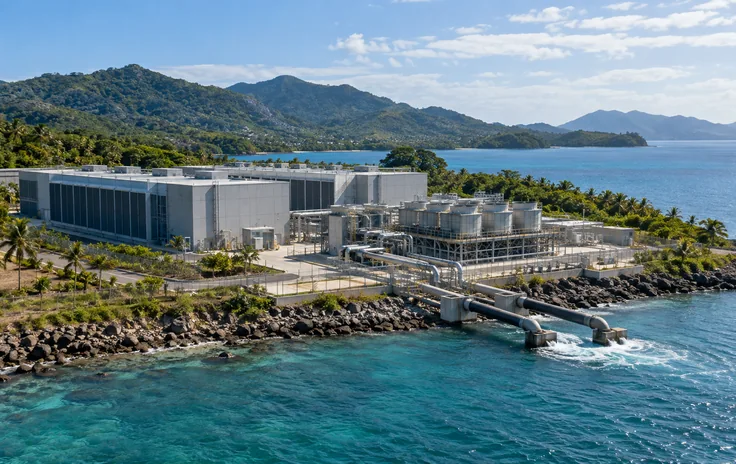
His article highlights a simple idea with complicated execution: use seawater as an external heat sink, typically through an indirect cooling system in which seawater passes through a heat exchanger and cools a separate sealed water loop serving the facility.
The approach has been used elsewhere for many years. Mah points to Singapore’s Changi Naval Base as a long-running example of seawater cooling, while large data centres in colder climates have also adopted seawater-based systems.
But his main point is caution rather than promotion. Seawater is corrosive, marine growth can foul pipes and heat-exchange surfaces, and poor design can create serious reliability problems. The technology is proven, but it is not a universal solution.
Read Paul Mah’s Tech Stories article
Why this matters to the Philippines
The question is relevant because water and cooling are already becoming part of Philippine data-centre planning.
In July 2026, Department of Information and Communications Technology Secretary Henry Aguda discussed water recycling and desalination as approaches that could reduce reliance on conventional freshwater sources. He pointed to coastal areas including Batangas, Bataan and Cagayan, where seawater could potentially support desalination.
A similar issue has emerged in Aurora. The Aurora Pacific Economic Zone and Freeport Authority has been promoting Casiguran as a potential location for future digital-infrastructure investment. In September 2026, APECO said discussions with prospective data-centre investors had included the possibility of a desalination facility so that future developments would not need to depend on freshwater or groundwater.
The Aurora proposal remains at an exploratory and investment-discussion stage. It should not be interpreted as an operating data-centre or desalination project.
Read the Philippine Information Agency report
Desalination is not the same as seawater cooling
The distinction matters.
With desalination, seawater is treated to produce freshwater, which can then be used within a cooling or water-management system.
With indirect seawater cooling, seawater itself becomes the external heat sink. It passes through a heat exchanger while remaining separate from the data centre’s internal cooling loop.
A third option, deep seawater cooling, uses colder water drawn from greater ocean depths.
Each approach has different engineering, energy, environmental and economic requirements.
DCAA perspective
For the Philippines, the important question is not simply whether seawater is available. As an archipelago, that is obvious.
The more useful question is whether seawater can be used reliably, economically and responsibly at a particular site.
Water temperature, seabed profile, pumping requirements, corrosion, biofouling, marine impacts, coastal hazards, maintainability and system redundancy would all influence whether a seawater-based solution makes sense.
That makes this a useful regional development to watch.
For DCAA, the wider point is that infrastructure innovation only delivers resilience when the people responsible for designing, operating, maintaining and assessing it have the capability to understand the trade-offs involved. As cooling approaches become more complex, professional understanding of thermal management, redundancy, maintenance, risk and resilience becomes increasingly important.
As data-centre growth continues across Southeast Asia, cooling and water strategy are likely to become increasingly important alongside power, connectivity and land. For the Philippines, the international experience provides useful ideas — but not a ready-made answer.
BUILD THE INFRASTRUCTURE. BUILD THE WORKFORCE.
Sources and further reading
- Paul Mah / Tech Stories — Can seawater keep data centres cool?
https://www.techstories.co/can-seawater-keep-data-centres-cool/ - DICT / GMA News — water recycling and desalination discussion
https://www.gmanetwork.com/news/money/companies/996709/amid-pax-silica-concerns-dict-says-modern-data-centers-use-water-recycling-as-cooling-tech/story/ - APECO / Daily Tribune — Aurora data-centre and desalination discussions
https://tribune.net.ph/amp/story/2026/09/23/apeco-talks-to-firms-for-data-centers-in-aurora-signs-mou-for-1-gw-re-investment - Philippine Information Agency — Aurora ecozone and sustainable AI data-centre plans
https://pia.gov.ph/news/luzon/cl/aurora-ecozone-gains-ground-as-site-for-sustainable-ai-data-centers/
Editorial Notice
DCAA Insights is provided for general industry information and professional education. Sourced information and third-party statements are attributed to their original publishers. DCAA commentary and analysis are identified as such. References to companies, projects or external resources do not constitute endorsement. External publications remain the intellectual property of their respective owners. Readers should refer to the original sources for the latest information.