))

DCAA INSIGHTS · RESEARCH & ANALYSIS
Research & Analysis ·
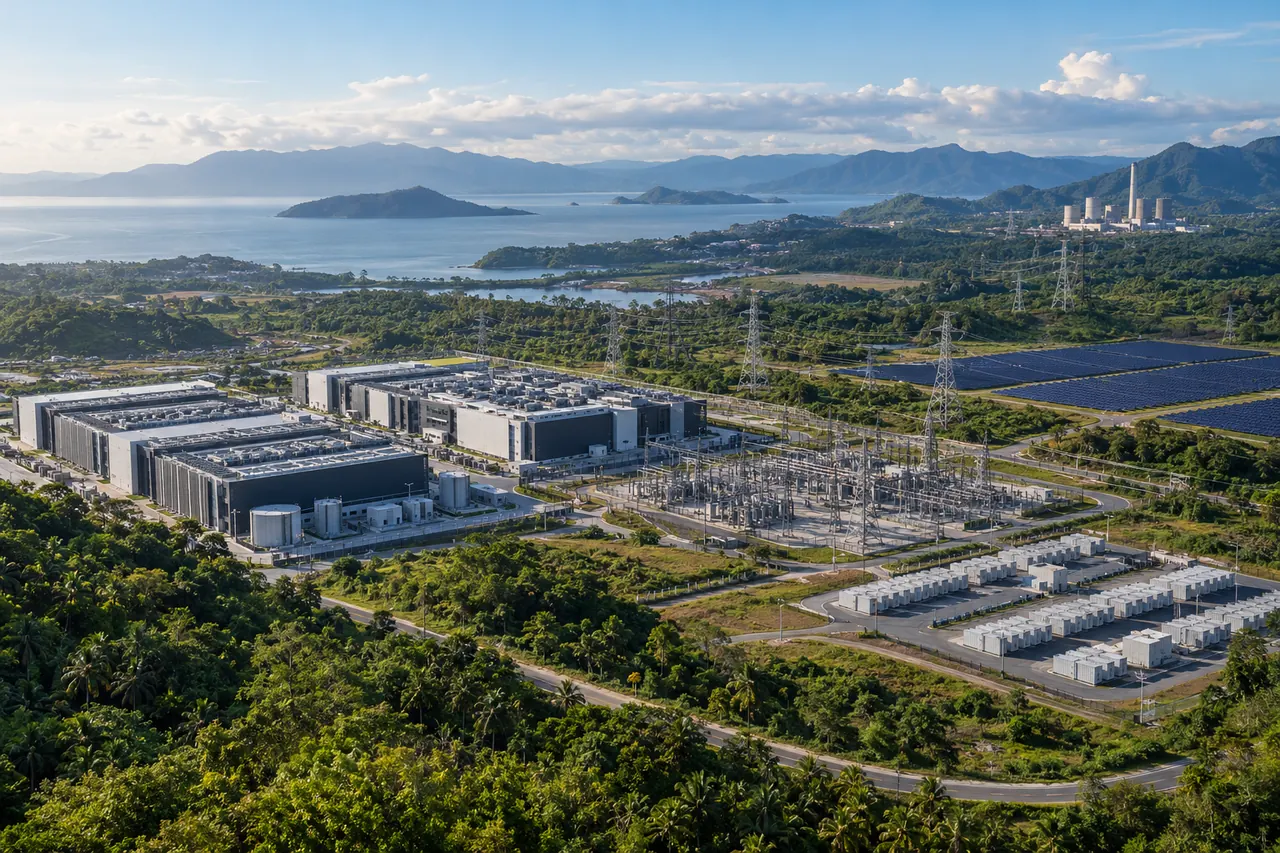
As Philippine data centres become larger and more power-intensive, the question is no longer simply whether the country can generate enough electricity. The harder question is whether reliable, scalable and increasingly sustainable power can reach the right locations, under the right commercial arrangements, when new facilities need it.
At a glance
Philippine data-centre development is entering a scale where energy infrastructure increasingly affects where facilities can be built, how quickly they can be developed and whether they can meet hyperscale and AI requirements.
There is no single obvious power supplier for the industry's next phase. MGEN, AboitizPower, ACEN, First Gen, San Miguel Global Power and other energy companies bring different combinations of generation, renewable energy, storage, retail supply, distribution access and wider infrastructure capability.
But generation capacity alone does not make a site data-centre ready.
The emerging question is whether the Philippines can combine:
Generation + Renewable Procurement + Grid Capacity + Distribution + Storage + Site Infrastructure + Facility Resilience + Skilled Operations
into an investable proposition.
Power is becoming part of site selection
The scale of individual Philippine data-centre developments shows why power can no longer be treated as an ordinary utility requirement.
STT GDC's Fairview campus in Quezon City has a planned development potential of 124 MW of IT load when fully built.
VITRO Sta. Rosa is designed for 36 MW of IT load, supported by a dedicated 60 MW substation.
A-FLOW's ML1 campus in Laguna is planned for 36 MW across three buildings, beginning with a 6 MW first phase.
These figures should not be added together as though they represent the entire Philippine market. They are facility-specific examples.
What they demonstrate is scale.
A development requiring tens — and potentially more than one hundred — megawatts of IT capacity cannot simply select a parcel of land and determine its electricity requirements afterwards.
Power becomes part of whether the location itself is viable.
That is why the recent MGEN–VITRO collaboration deserves attention. Their feasibility work explicitly brings potential sites, generation capacity, renewable resources, connectivity and data-centre specifications into the same discussion.
But the Philippine electricity system is broader than MGEN and Meralco.
Generating electricity is not the same as delivering it to a data centre
One of the most important distinctions for understanding the Philippine market is that the company generating electricity does not necessarily own the infrastructure delivering it to the facility.
Large customers operate within an electricity ecosystem involving:
Generation companies → Transmission → Distribution utilities → Retail electricity suppliers → End-users
Since June 2026, the Energy Regulatory Commission has lowered the threshold for Retail Competition and Open Access to 100 kW, expanding the number of eligible customers able to choose a licensed retail electricity supplier.
For a hyperscale data centre consuming many megawatts, that eligibility threshold is obviously not the limiting factor.
More relevant is that large customers can potentially structure commercial electricity supply differently from ordinary captive residential consumers.
The ERC's supplier directory includes renewable and retail suppliers associated with companies such as ACEN, AboitizPower, First Gen and Meralco, alongside other market participants.
This means the question:
“Which generator is closest to the data centre?”
is not necessarily the same as:
“Who supplies the data centre's electricity?”
And neither question answers another important one:
“Can the electricity actually be delivered to the site at the capacity and reliability required?”
That brings transmission, substations and distribution infrastructure into the equation.
Who are the major players to watch?
MGEN and the wider Meralco ecosystem
MGEN currently provides the clearest example of an energy company explicitly exploring integrated data-centre development.
Its agreement with VITRO covers potential sites, generation capacity, renewables, connectivity, facility requirements and power-supply structures.
This is significant because much of the country's current large-scale data-centre activity is concentrated around Greater Manila and the CALABARZON corridor, where the wider Meralco ecosystem has substantial infrastructure presence.
However, this should not be interpreted as meaning Meralco or MGEN will automatically supply future facilities.
The data-centre market increasingly extends beyond one franchise area and one development model.
AboitizPower and the wider Aboitiz ecosystem
Aboitiz presents a particularly interesting model because its wider group already participates across several infrastructure layers.
AboitizPower operates across generation, distribution and retail electricity, while Aboitiz InfraCapital has entered the Philippine data-centre industry through its partnership with EdgeConneX. Aboitiz Economic Estates also develops major industrial estates supported by utilities and infrastructure.
That matters because the future competition for digital-infrastructure investment may increasingly involve more than an electricity tariff.
A potential locator may be evaluating:
industrial land + electrical capacity + utility infrastructure + connectivity + permitting + water + logistics + workforce access
as one proposition.
The Aboitiz structure shows how several of those components can potentially sit within the same wider business ecosystem.
ACEN and renewable electricity supply
ACEN brings a different strength.
At the end of 2025, ACEN reported more than 2,400 MW of attributable renewable capacity in the Philippines, with 57% operational.
Its retail business, ACEN Renewable Energy Solutions, reported a 482 MW portfolio across 753 customers and said it accounted for 65% of electricity supplied through the Green Energy Option Program.
For hyperscalers and other multinational technology companies with renewable-energy and emissions commitments, the ability to procure renewable electricity can materially influence investment decisions.
That does not mean ACEN has been selected to power the next Philippine hyperscale facility.
What it demonstrates is that the commercial mechanisms required to supply large corporate customers with renewable electricity already exist and are developing.
First Gen and firm renewable generation
First Gen adds another dimension because of the composition of its portfolio.
At the end of 2025, First Gen reported 1,764.2 MW of installed renewable capacity, including approximately:
- 1,302.8 MW geothermal
- 299.4 MW hydro
- 150 MW wind
- 12 MW solar
Geothermal is particularly relevant in a data-centre context because it can provide continuous renewable generation rather than depending on sunlight or wind availability.
That distinction matters.
Solar and wind are increasingly important to decarbonisation, but data centres require continuous electricity.
A data-centre energy strategy therefore has to consider not only how much renewable electricity can be procured over a year, but when that electricity is available and what supports the facility when variable generation is not producing.
Geothermal, hydro, storage, the wider grid and other dispatchable resources can all play different roles in that equation.
San Miguel Global Power and grid-scale storage
San Miguel Global Power is another large participant in the Philippine generation market and has also been developing a significant battery-energy-storage portfolio.
Its disclosures show continued investment in BESS facilities across multiple locations, with storage being used in part to provide ancillary services and support grid stability.
Grid-scale batteries should not be confused with a data centre's own UPS or standby-generation systems.
They solve different problems.
But storage becomes increasingly important at system level as the proportion of variable renewable generation increases, helping provide frequency response, reserves and other grid services.
For future data-centre growth, that wider system flexibility matters.
And the list does not stop there
The Philippine market contains many more licensed retail and renewable suppliers than these major groups alone.
For DCAA Insights, the larger companies are worth tracking because of their scale, infrastructure positions and potential alignment with major data-centre developments.
But the market should not be described as though they are the only possible suppliers.
Renewable energy is necessary — but it does not solve the entire problem
The Philippine government is actively expanding renewable-energy development.
In February 2026, the Department of Energy announced a ten-year Green Energy Auction programme targeting at least 25 GW of additional renewable capacity through 2035, supporting national targets of 35% renewable energy by 2030 and 50% by 2040.
For data-centre investors, growing renewable supply is important.
But reliable digital infrastructure requires electricity continuously.
That means a power strategy has to consider how renewable generation interacts with:
storage, firm generation, grid capacity, multiple utility feeds, substations, on-site UPS systems, standby generation and operating procedures.
Different technologies solve different parts of the resilience problem.
A large solar project can reduce carbon intensity.
It does not replace the need for a resilient electrical architecture.
A grid-scale battery can support the electricity system.
It does not replace the data centre's UPS.
A highly redundant facility design can protect critical IT load.
It cannot compensate indefinitely for insufficient upstream electricity infrastructure.
The strongest proposition is therefore a system, not a single technology.
The network could become the real constraint
This is where national generation numbers can be misleading.
A country can add thousands of megawatts of generation capacity and still encounter difficulty connecting a major new load at a particular site.
Electricity has to move through transmission infrastructure and then through the relevant distribution network.
For data-centre developers, this means questions around:
available substation capacity;
connection lead times;
transmission constraints;
dual feeds;
planned network reinforcements; and
power quality
can matter as much as the nameplate capacity of a generating plant.
The critical distinction is:
Installed national generation capacity is not the same as deliverable capacity at a proposed data-centre site.
Geography will determine which energy ecosystem matters
The answer will also vary depending on where the facility is built.
Greater Manila remains the country's largest established market, but significant development now extends through Cavite, Laguna and Batangas.
Central Luzon has activity around Clark and Angeles.
Cebu and Davao provide important regional nodes.
That means the relevant combination of generators, distribution utilities, substations, renewable projects and transmission infrastructure will differ from one location to another.
This is why DCAA's developing Philippine Data Centre Activity Map could eventually become even more useful with an energy-infrastructure layer.
The question would no longer simply be:
Where are the data centres?
It could evolve into:
Where are data-centre clusters, power infrastructure, industrial estates, renewable-energy opportunities and connectivity corridors beginning to converge?
That would provide a stronger picture of actual market readiness.
The workforce and operational question
Power planning is only the upstream side of the issue.
Once electricity reaches the site, it still has to be transformed, distributed, protected, monitored and maintained through mission-critical infrastructure.
Large data-centre environments depend on competence around:
utility interfaces and substations;
switchgear and protection;
UPS and batteries;
standby generation;
automatic transfer arrangements;
power quality;
energy management;
cooling interaction;
redundancy;
commissioning;
maintenance;
risk management; and
operational assurance.
As AI increases power density, the relationship between electrical systems, cooling and operational resilience becomes even more important.
This is where energy readiness and workforce readiness meet.
A country can build generating capacity and attract data-centre investment, but resilient digital infrastructure ultimately depends on the people capable of operating and assessing the systems connecting the two.
Power readiness and workforce readiness are not separate questions.
They are part of the same infrastructure-readiness equation.
DCAA perspective: the answer is likely to be a combination, not a company
So who could power the next generation of Philippine data centres?
There is unlikely to be one answer.
MGEN brings generation and renewable capability together with an explicit emerging digital-infrastructure collaboration.
AboitizPower and the wider Aboitiz Group combine energy, utilities, economic estates and direct participation in data-centre development.
ACEN brings large-scale renewable development and an established commercial renewable-supply platform.
First Gen brings substantial geothermal and hydro resources with characteristics that can complement variable renewable generation.
San Miguel Global Power brings major generation scale and significant investment in grid-scale storage.
Other retail suppliers, renewable developers and utilities will also participate.
For any individual project, the stronger proposition may therefore be a combination of:
Generation + Renewable Procurement + Storage + Grid Connection + Distribution Infrastructure + Facility Resilience + Operational Capability
The Philippines' opportunity is not simply to generate more electricity.
It is to create locations where large quantities of reliable, commercially viable and increasingly sustainable power can actually reach digital infrastructure when it is needed — and where skilled people can operate that infrastructure once it arrives.
BUILD THE INFRASTRUCTURE. BUILD THE WORKFORCE.
Selected primary sources
- MGEN — MGEN–VITRO power-enabled digital infrastructure MOU (October 2026).
- Aboitiz Group — Energy, infrastructure, estates and data-centre activities (October 2026).
- ACEN — 2026 Annual Stockholders' Meeting operating update (October 2026).
- First Gen — 2025 renewable-energy portfolio (October 2026).
- Energy Regulatory Commission — Philippine electricity-supply market and licensed suppliers (October 2026).
- Department of Energy — 25 GW Green Energy Auction roadmap (October 2026).
- Board of Investments — Data Center and Power Southeast Asia Summit 2026 (October 2026).
Editorial Notice
DCAA Insights is provided for general industry information and professional education. Sourced information and third-party statements are attributed to their original publishers. DCAA commentary and analysis are identified as such. References to companies, projects or external resources do not constitute endorsement. External publications remain the intellectual property of their respective owners. Readers should refer to the original sources for the latest information.